

Why 19th Century Base Balls Are Worth Your Attention
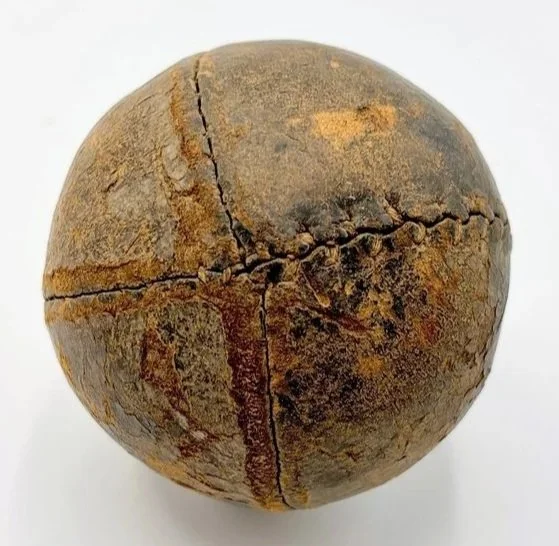
I own two 19th century baseballs. One is from the 1890s. The other is from the 1850s — and that one is my grail. I waited my whole collecting life for it, and I found it at auction buried in a lot. If you've ever held a baseball that old, you already understand why someone would wait a lifetime for one. If you haven't, I hope this post gives you some sense of what you're missing.
I've always been drawn to old baseballs. The older the better, as far as I'm concerned. There's something about holding the actual object at the center of the game that connects you to baseball history in a way nothing else quite does. And the further back you go, the stranger and more fascinating that object becomes. The baseball of the 1850s is not the baseball of today in any meaningful sense. It was handmade, unstandardized, and deeply personal — as much a craftsman's signature as a piece of sporting equipment.
Most of what I know about these balls in any serious depth I owe to Eric Miklich and his remarkable website, 19cbaseball.com. If you have any interest in this subject at all, stop reading this and go spend an hour there. His research is exhaustive, meticulously sourced, and represents years of dedicated work on a topic that most of the collecting world has barely scratched the surface of. What follows here draws heavily on what he's documented, and I want to be completely clear about that. My goal is simply to share what I've found — and to point you toward the man who actually did the work.
The early baseball — the kind my 1850s ball represents — was built around a core of almost anything solid its maker had available: india-rubber cut from old shoes, fish eyes, rocks, or nuts, wound tightly in yarn and enclosed in a single piece of brown leather stitched in what was known as the "lemon peel" or "rose petal" style. The four sides of that one piece of leather were sewn shut in an X configuration, giving the ball its segmented, lemon-like appearance. These balls were light, soft, and entirely individual. A maker who packed in more rubber and wound the yarn tightly produced a "lively" ball; one who used less rubber with a looser wind made a "dead" ball. Visiting teams exploited this knowledge strategically. The men who made these balls were craftsmen in the truest sense — Harvey Ross, a sail maker from Brooklyn who stamped every ball with his personal trademark; John Van Horn, a shoemaker at 33 Second Avenue in New York who supplied the Knickerbocker Club and has been called "the greatest ball maker of the 19th century." These weren't products. They were a maker's reputation in leather and yarn.
The figure-eight stitched ball that we recognize today began to take hold in the late 1850s and early 1860s, its origins still debated. Ellis Drake, a shoemaker's son from Stoughton, Massachusetts, claimed to have sketched the two-piece design as a schoolboy after noticing that lemon peel balls came apart at the corners and threw erratically. He made a prototype from his father's scrap leather and said the Wright brothers began copying the design shortly after — yet he never patented it and died in 1912 without formal credit. Others point to Colonel William A. Cutler and the Harwood factory in Natick, Massachusetts — the first baseball factory in America — as the true origin of mass production. By 1872, the figure-eight ball was the exclusive standard at the professional level, the core was required to be vulcanized molded rubber rather than the more elastic strip rubber, and the dimensions had settled into essentially what we use today. By 1878, Albert Spalding had maneuvered his way into becoming the exclusive official ball supplier to the National League — a relationship that would last nearly a century.
My 1890s ball exists at the far end of that standardization story. My 1850s ball exists almost entirely outside of it. The gap between them — in construction, in philosophy, in the very idea of what a baseball was supposed to be — is part of what makes collecting so compelling. If you want to understand it properly, go read Eric Miklich's work at 19cbaseball.com. And if you ever come across either style at auction, pay attention. They don't come up often, and the good ones don't last long.
Primary research credit: Eric Miklich, 19cbaseball.com
Finding Nostalgia provides USPAP-compliant appraisal reports with a specialty in vintage sports memorabilia. Learn more about our appraisal services or contact us to get started.
